You got Captain RedFlag.
You're not careless. You may just be stuck in the very convincing habit of making a questionable route look official.
Captain RedFlag is the part of you that can spot a warning sign, feel the pause, notice the mismatch, and still say, with impressive confidence, "It's probably fine."
Hope is involved. Momentum is involved. A plan is already in motion. And sometimes the hardest sign to read is the one that asks you to admit you already knew.
Meet Captain RedFlag.
Captain RedFlag is the face of the pattern. He's charming, official, map-heavy, and suspiciously confident near obvious danger. He doesn't think he's ignoring warning signs. He thinks he's maintaining morale, protecting the plan, and interpreting the route with nuance.
He represents charming misdirection, false confidence, ignored warning signs, and avoidance disguised as planning.
This might sound familiar.
The Misdirected Navigator is the part of us that wants the map to be right because changing course would cost something.
Captain RedFlag rarely storms into disaster. He arrives with a folded map, a broken compass, and a calm voice saying the bridge's rotten slats are what gives it character.
Hope probably helped you keep going.
Maybe it helped you stay steady.
Maybe it helped you believe something could still work.
Maybe it kept you from panicking too soon.
Maybe it helped you be patient.
Maybe it gave people room to grow.
Maybe it helped you survive a season when stopping felt more painful than continuing.
You're not here because you were foolish. You're here because some part of you got invested in the route.
Hope was involved. Loyalty was involved. Pressure may have been involved. Pride may have been nearby pretending to be strategy. Fear may have worn a staff polo and called itself wisdom.
This result isn't here to make your past self the villain. It's here to help your present self read the sign without turning the moment into a trial.
A warning sign does not demand panic. It asks for attention. Attention is navigation.
Ignoring the sign usually costs more than reading it.
When The Misdirected Navigator takes over, the sign becomes inconvenient. Then the inconvenience gets explained away. Then the explanation becomes the new map.
Something feels off.
You reframe it quickly.
You add more context, patience, or optimism.
Momentum starts to feel like proof.
The sign becomes the problem instead of the route.
Real hope can tolerate information. Denial needs the map folded, the room dimmed, and the warning signs called "vibes."
You don't have to become suspicious of everything.
Reading the signs doesn't mean treating every delay, weird feeling, or unclear moment like a disaster.
Some signs mean stop. Some signs mean slow down. Some signs mean ask a better question. Some signs mean update the route. Some signs mean the bridge is making a wooden screaming noise and maybe we should stop calling that "character." The shift is simple, but not always easy.
Instead of asking: "How do I make this sign less inconvenient?" — Ask: "What's this sign telling me about the route?"
That question helps separate real strategy from avoidance, useful signals from static, and honest hope from wishful thinking.
You can turn around, slow down, ask a question, set a boundary, or change the plan without calling it failure.
Your next step: The Read the Signs Field Guide
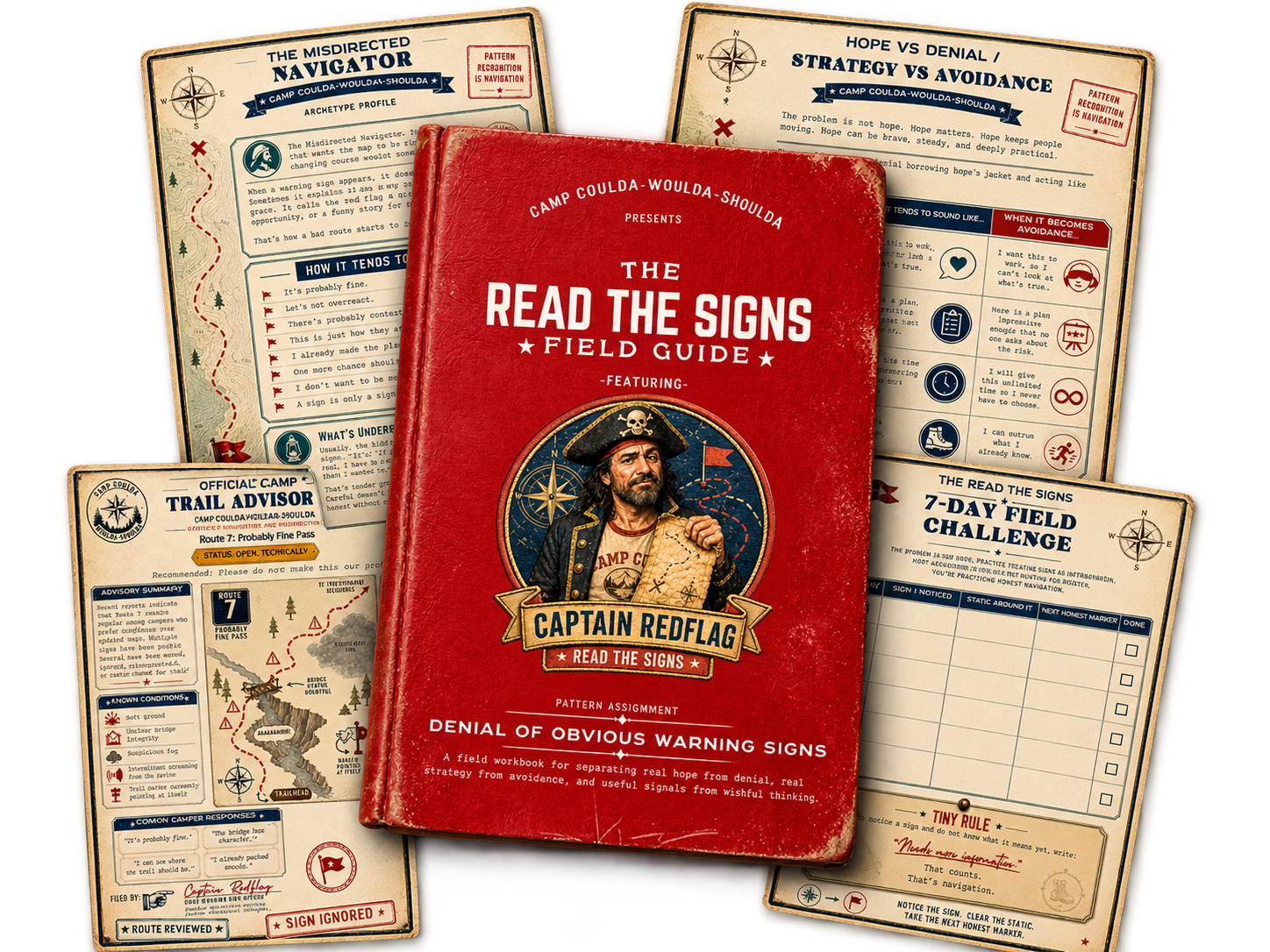
The Read the Signs Field Guide is a digital workbook for adults who are ready to stop treating warning signs like inconveniences.
It helps you name the route, read the signal, clear the static, and choose the next best marker.
Camp Supplies
Take a Peek Inside
This isn't generic digital-product PDF slop. Each Field Guide has been carefully crafted by a team of humans to help you recognize a pattern and get the hell out of it. No two Field Guides are the same, and each one takes you a little deeper into this absurd fictional summer camp staffed by dysfunctional monsters.
Made by Humans. Helped by Machines.
Camp Coulda-Woulda-Shoulda Field Guides are written, edited, art-directed, and designed by real people. AI-assisted tools were used along the way for select artwork and creative development.
What the Field Guide helps you do:
Name the route you have been following.
Identify the first weird marker you explained away.
Separate signal, static, and story.
Write the warning sign without softening it.
Sort hope from denial and strategy from avoidance.
Choose a stop, slow, ask, boundary, change, or turn-around move.
Practice a 7-day Read the Signs field challenge.
This guide is for you if…
You can spot something off, then explain it beautifully.
You keep hoping the route will make sense after one more turn.
You worry that naming the sign will make you dramatic.
You're tired of letting confidence outrun clarity.
You want a practical way to reflect without spiraling.
You need a kind but honest way to update the route.
Digital download. Start whenever you are ready. Captain RedFlag has already approved several questionable routes, so maybe do not wait on him.
Captain RedFlag would like to assure you the route is probably fine.
Classic Captain RedFlag.
But if this result made you feel seen, there's probably a reason. You don't have to rethink every decision you have ever made. You only need to read the next sign clearly enough to choose the next best marker.