You got Chaos Dragon.

Crisis loops, urgency addiction, and survival-mode productivity
Welcome to Camp Coulda-Woulda-Shoulda, where the cabins are damp, the schedule's theoretical, and somebody just yelled, "WHO LEFT THE STRATEGY DOCUMENT NEXT TO THE KINDLING?"
Chaos Dragon is Camp's expert in crisis loops, urgency addiction, and survival-mode productivity. He means well. Usually. He skips planning, waits until smoke's visible, then treats the fire drill like leadership development.
You may be great in a crisis—but crisis mode may have become your operating system.
This pattern is proactively reactive.
You're not sitting around doing nothing. You're moving fast, solving problems, answering urgent messages, and becoming the person everybody looks at when something catches fire.
You may say, "I work better under pressure."
You may say, "Planning takes too long."
You may say, "It's fine. I've handled worse."
You're taking plenty of action. It's just happening after urgency has chosen the agenda.
You might be hooked on the rush of saving the day—even when you kinda started the fire.
There's a rush in the last-minute rescue. The deadline tightens, the noise drops, your brain locks onto one target, and you pull off something that looked impossible an hour ago.
The pattern may also create the rescue: waiting for clarity, postponing the conversation, saying yes too quickly, or letting pressure build until adrenaline makes your brain come online.
That doesn't make you reckless. It means the pattern rewards you. The work is creating momentum without smoke, panic, and a countdown clock.
Chaos still costs you—even when you save the day.
"It worked" isn't the same as healthy, repeatable, clear, sustainable, or necessary.
Reactive patterns cost recovery time, trust, better decisions, creative energy, emotional bandwidth, and the ability to tell a real emergency from a loud distraction.
When everything's urgent, nothing gets prioritized.
When every problem becomes yours, ownership gets blurry.
When you act only after something's smoking, prevention never gets a turn.
You don't need to kill the dragon. You need to stop letting him run Emergency Management.
Not about becoming a calm forest ranger with a plan for every squirrel sneeze.
Not about eliminating urgency or pretending pressure doesn't exist.
Not about fixing your personality.
Chaos Dragon isn't the enemy. He's the part of you that learned to survive pressure, improvise, and keep moving when things got messy.
He's a terrible long-term strategist. The goal is to build firebreaks: clearer deadlines, named owners, buffers, weekly smoke checks, boundaries, earlier conversations, and simpler versions delivered on purpose.
The smoke usually started before you smelled it.
From the Observation Deck, this pattern's easy to spot: smoke in three directions, a camper sprinting with a clipboard, and Chaos Dragon insisting the flames add "ambience." Pressure shouldn't have to become your operating system before you can focus, decide, or move, Champ.
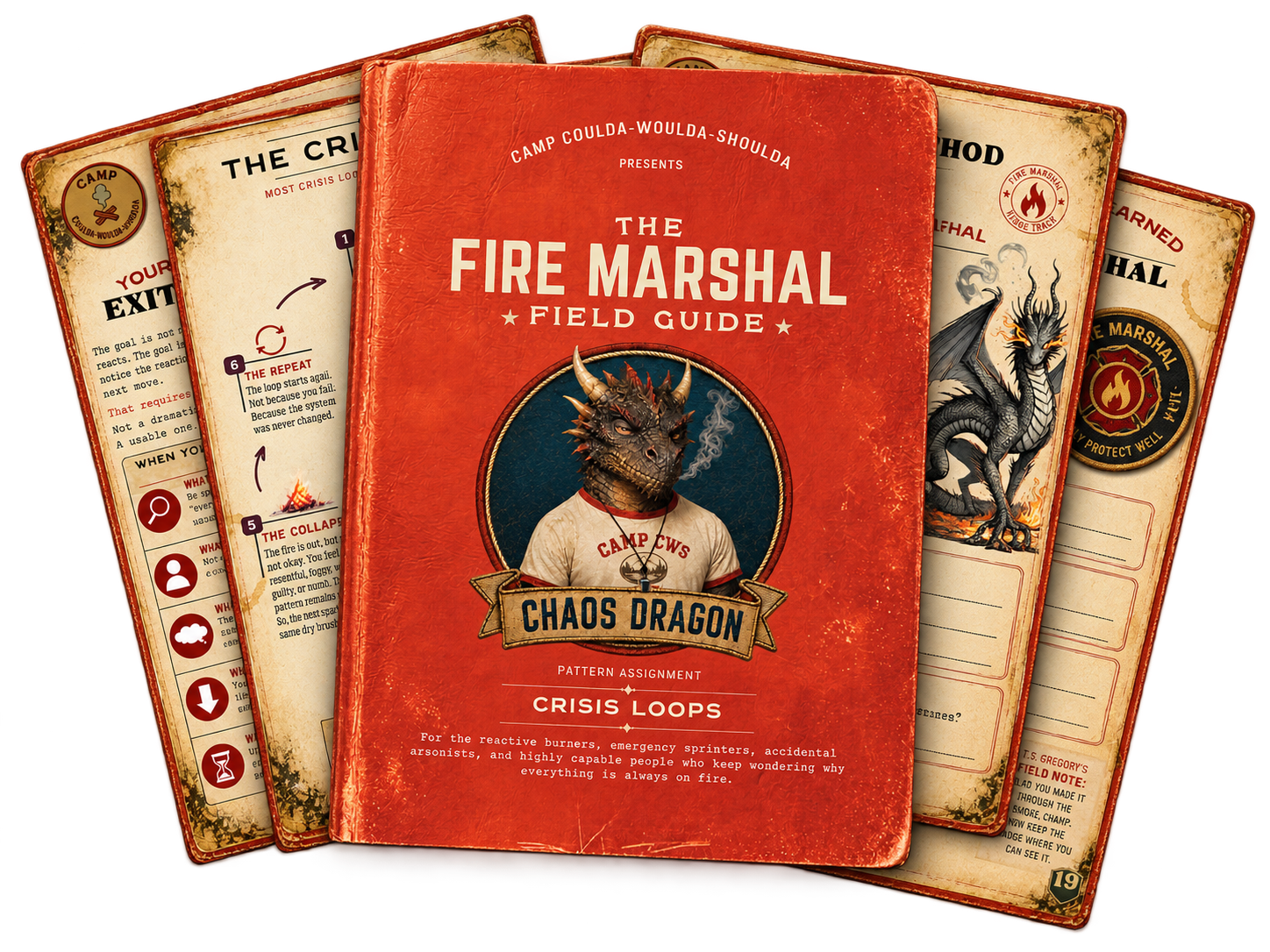
The Fire Marshal Field Guide helps you spot the smoke before everything catches.
This digital workbook helps you identify recurring fires, separate actual emergencies from noisy distractions, and build firebreaks so you can respond instead of react. It's a field kit for capable people who are done confusing panic with momentum.
Camp Supplies
Take a Peek Inside
This isn't generic digital-product PDF slop. Each Field Guide has been carefully crafted by a team of humans to help you recognize a pattern and get the hell out of it. No two Field Guides are the same, and each one takes you a little deeper into this absurd fictional summer camp staffed by dysfunctional monsters.
Made by Humans. Helped by Machines.
Camp Coulda-Woulda-Shoulda Field Guides are written, edited, art-directed, and designed by real people. AI-assisted tools were used along the way for select artwork and creative development.
Digital download · PDF · Instant access
What it does
Helps you identify your recurring fires and what's actually igniting them.
Gives you a filter to separate real emergencies from loud distractions.
Walks you through building firebreaks that fit how you actually work.
Helps you respond instead of react—without eliminating your edge.
Inside the download
Chaos Pattern Audit
Map your recurring fires and trace them back to their source.
"Is It Actually On Fire?" filter
A fast decision tool for separating urgency from noise.
Fire Map
Visualize where your energy goes when things heat up.
Before-It-Burns checklist
Proactive steps to take before pressure builds.
Weekly Smoke Check
A short weekly review to catch problems early.
Calm Communication scripts
Language for de-escalating before the alarm goes off.
7-Day Firebreak Challenge
A structured week to practice responding instead of reacting.
Personal Firebreak Plan
Your custom system for fewer preventable fires.
This is for you if…
You're excellent in a crisis but exhausted afterward.
You wait until pressure builds before acting.
You confuse urgency with importance.
You become the default person when things go wrong.
Deadlines suddenly give you energy.
Chaos may be part of your story. It doesn't need to run the whole campground.
Earn the Fire Marshal Badge.
Interrupt crisis loops, reduce preventable chaos, and build simple systems before the next fire drill takes over.
You've already proved you can survive the fire. This Field Guide helps you stop scheduling the next one.